Wednesday, 19 December 2012

John Shaw


John Shaw, another nature photographer, uses WB creatively on occasion. In this photograph he tries to stress the tranquillity by giving the impression of the warm sunshine from the sunrise.To achieve this effect he is a WB slightly too warm (to preserve the warm tones)


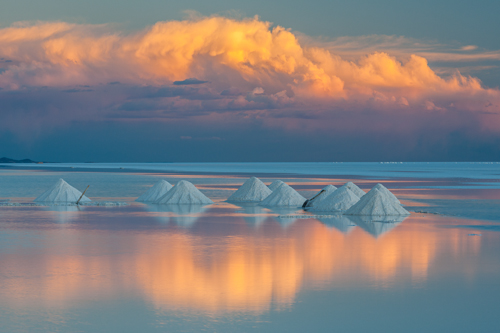
Again a similar idea for this photograph of the Salar de Uyuni. He  preserves the warm tones to emphasise the sunset this time instead of the sunrise (the tones are more orange than yellow). Again this adds colour to the photograph and brings it to life.


I really like this photograph simply because...it's just so green! And there are so many different shades. There seems to be slightly green cast to this photograph, I suspect deliberately used to emphasise the scenes 'green-ness'. 

Joe Mcnally

Joe Mcnally is a diverse photographer, from photojournalism to commercial photography. However he uses WB in all fields to add an ambience to the photograph. This photograph is called 'Bookstore Owner' and I think the colour temperature is slightly too warm (so the WB is not cool enough) and I think it is to give the impression of it being a warm happy place (look at him cuddling that dog!!!)


In this photo, named 'Ice Fishing', the colour temperature is very cool make the scene seem colder than it is. With blue being a 'cool' we tend to associate it with water, snow and ice. Also it seems to highlight the fact that there is no sunlight.


Similarly to the photograph on the left, his photo of a ice hockey goalie and the teams cheerleaders (photograph called 'Mike and the Rockettes') the colour temperature is cool to emphasise the ice in ICE hockey...clever eh?

Ian Plant


Ian Plant, a nature and wildlife photographer, uses white balance creatively to set a mood. He either selects the WB required when taking the photograph or take the photograph in RAW and adjust the WB later in photoshop.


In both the photographs above and to the left, Plant has opted to   ensure that the colour temperature remains cool. For the photograph above, it is to highlight the water and extenuate its 'blue-ness' and for the photograph to the left, it is simply to intensify how cold we perceive it to be in (adding warm tones would give the impression it is warm so not as much of an impact) 


In the photograph to the right, he chose to deliberately use a warm colour temperature because the sunset, when combined with the WB chosen gives this photograph more impact and conveys the atmosphere he is attempting to create.

WB Settings

To compensate for the colour cast from the light source, there are many different options with very different effects...

 Auto WB
Camera uses an algorithm to calculate the light temperature and estimates the best WB for it. However only works with a limited range of temperatures.


Custom
This setting allows to manually adjust the WB by choosing what combination of each colour (Green, Megenta, Blue and Yellow). Some cameras also offer the option of setting the WB by choosing a colour temperature


Tungsten (approx. 3000K).
This light arises from a bulb that produces a light even cooler than fluorescent bulbs.This setting works by cooling the colour temperature of the photograph.

Fluorescent (approx. 4000K)
This light is cooler than tungsten however still very warm. This setting works by cooling the colour temperature of the photograph.

Daylight (approx. 5000K)
This setting is seen as the neutral setting, where the light has a roughly even proportion of all light waves however it adds a little warm tones.

Flash (approx. 5000K)
This setting is very similar to daylight (in the sense that it is seen as almost neutral) however it also takes into account the flash

Cloudy (approx. 7000K)
This setting is for when it is overcast so light is limited. To compensate the cool colour temperature, warm tones are added.

Shade (approx. 8000K)
This setting is for when there is very limited light and the colour temperature is very cool, so a lot of warm tones are added.

Here are examples of the effects of each setting...

White Balance...

"Method used for accurately recording the correct colour in different light sources"- John Freeman, Digital SLR Handbook.

Different light sources have different colour temperatures and WB takes this into account to ensure what is white APPEARS to be white in the photograph. DSLR cameras cannot adjust to different light sources automatically (unless you select the Auto WB option, but I find sometimes it's not very accurate). z takes this into account to ensure what is white APPEARS to be white in the photograph.Light is made up of a spectrum of invisible waves and the proportions of these different 'coloured' waves are different in each light source. So if there is an abundance of say... infra red waves, the photograph may end up with a red cast. This can be avoided by adjusting the WB.


Notice how the photograph drastically changes when different WB settings are used. The {daylight} photograph is obviously too 'warm', hence the yellow cast. On the other end of the spectrum is the {tungsten} which appears to have a blue cast, suggesting that the WB is now too cool. Somewhere in-between is the fluorescent setting which works quite well.

Tuesday, 18 December 2012

Camera Types

There are several types of cameras ranging from digital to film, large to small format, still to camcorders...

    Plate Glass Cameras 


  • First type of camera.
  • Were called the plate camera because they contained sensitised glass plate, designed to contain the photograph.
  • Later the glass plate was replaced by sheet film.
  • To focus, they used a ground glass. 


Examples include...
  • Anthony & Scovill Ansco No. 7
  • Bermpohl & Company Bermpohl-Naturfarbenkamera
  • Lancaster & Son Aluminum Bound Pocket Instantograph
Advantages
Disadvantages
High quality outcome at the time
Focusing was very difficult (hence the ground glass and using a dark sheet on top of camera and photographer)

Very limited aperture (only small apertures)

Very big and not very portable.

Large Format Cameras


  • Successor to the plate glass camera
  • Structure very similar to that of plate glass camera
  • 4x5 inches or larger.
  • Unlike plate glass camera, use only sheet film.
  • Three main types...
1. view with a) monorail (where there is greater variety of movement) and b) field (that folds but is limited in movement)
2. press (so called because they were used by 'the press')

Examples include...
  • Tachihara 4 x 5
  • Sinar X
  • Calumet Cadet 

Advantages
Disadvantages
Produces very high quality photographs
Still quite large
Offers a wide range of depth of field
Expensive and costly to maintain (lenses, film, produce photographs from negatives etc)
Negatives can be avoided by buying digital backs instead of film
 Generally used for still subjects.

 Very slow to use

Medium Format Cameras


  • Uses film of 6x4.5cm to 6x9cm
  • Similarly to large format, medium format cameras can have rollfilm backs or digital backs.
  • Don't contain bellows like its predecessors


Examples include...

  • Rolleiflex 2.8F
  • Mamiya C330
  • Hasselblad 500C/M

Advantages
Disadvantages
Produces very high quality photographs
Still quite heavy.
Offers a wide range of depth of field
Can be expensive
Negatives can be avoided by buying digital backs instead of film
Film is also expensive
Small and light relative to large format cameras therefore more portable

35mm Rangefinder Cameras


  • Used 35mm film (surprise surprise!)
  • Produced to increase precision when focusing.
  • Two separate viewfinder in early models (when vertical lines from both viewfinders overlap, photograph is in focus)
  • Later the two viewfinders where combined
  • Generally, they were out competed by SLR's

Examples include...

  • Kodak 35 Rangefinder
  • Detrola 400
  • Leica M6 
Advantages
Disadvantages
Very small and light
Generally cannot accept zoom lenses
Interchangable lens
Field of View changes with a change in distance to the subject
Image captured through the lens therefore no parallax (what you see is what you get)
Can be easily misaligned (therefore not in focus
Very precise focus


SLR's, TLR's and DSLR's

 All of the above, except the 35mm Rangefinders are available in Single-Lens Reflex (SLR) and Twin-Lens Reflex (TSLR)...

SLR's- only one lens so that the lens acts as viewfinder and to capture photograph.
TLR's- Has two lenses, one for taking the photograph and one acts as a viewfinder lens.
Advantages
Disadvantages
Advantages
Disadvantages
Uses mirrors so doesn't have a parallax effect
More expensive due to more expensive mechanism
Cheaper due to simpler design
No zoom lenses and limited cameras have interchangeable lenses
More common therefore more variety
Due to complicated design cannot be made small like Rangefinders.
Useful for long exposures because the viewfinder lens remains open
Waist level finder causes inconveniences
Interchangeable lenses therefore greater variety of lenses as well


No digital TLR’s
Allows for Digital SLR’s (called DSLR’s)


In 2000, Kodak released the first DSLR, which was very different from its SLR predecessors...

DSLR's
Advantages
Disadvantages
Can view photographs instantly
Larger and heavier than SLR
Doesn’t need film therefore less expensive in that sense.
Much more expensive that SLR’s
Greater variety of interchangeable lenses
Very poor battery life in comparison
More options (e.g. can easily change ISO)

Monday, 17 December 2012

Investigating shutter speeds

Inspired by Tom Jenkins and decided to stick to a sport themed experimentation... i.e. I used a tennis ball. I wanted to see how different shutter speeds affected the outcome when attempting to take the same picture. So I cracked open my tripod and these are the results (I warn you...they are not very good!)...


                                    SS: 1/4000 F:3.5                              SS: 1/1000 F:3.5


                                      SS: 1/250 F:3.5                                SS: 1/60 F:3.5


                                    SS: 1/4 F:3.5                                    SS: 1'' F:18

 My conclusion from this very unscientific experiment are what I expected them to be. I was however interested to see little difference between the 1/4000 and 1/1000. I concluded that to see a difference the subject must be moving faster that the average tennis ball under the influence of gravity...